
Building Stronger Communities in Desa Tanggeran: How PT Nesia’s CSR Supported 22 Farmers With Tools for Better Coconut Sugar Production
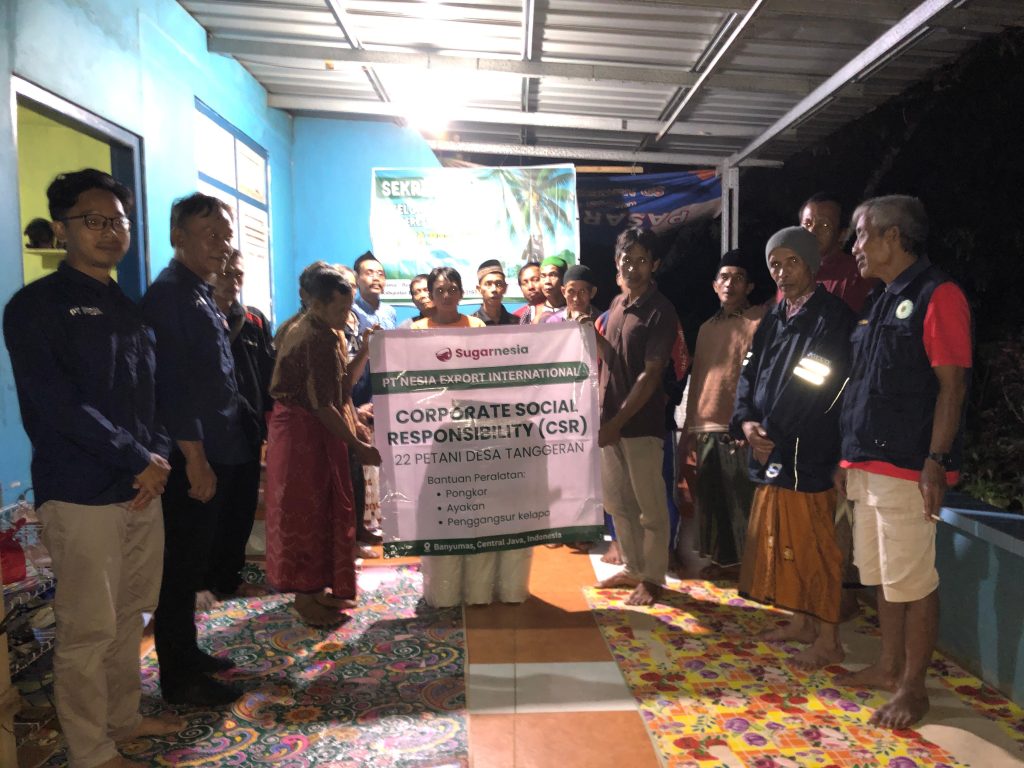
Corporate Social Responsibility is not just about donating resources. It is about creating solutions that match the real needs of people and building programs that uplift communities in a way that lasts. PT Nesia Export International has proven its commitment to this principle through a CSR program in Desa Tanggeran, Central Java. In this initiative, 22 local farmers received much-needed equipment including pongkor, sieves, and coconut processing tools. The result has been a significant improvement in their production process, their confidence, and their sense of pride as contributors to Indonesia’s growing reputation in the global organic coconut sugar market.
Desa Tanggeran is a small village with a strong heritage of coconut farming. Coconut trees stand tall across the village, and for generations, families have tapped their blossoms to collect nectar, transforming it into the rich and caramel-like coconut sugar. Although the process has been passed down for decades, the challenges farmers face have not changed much. Most still rely on simple tools, many of which are old, heavy, or worn out. Working with limited resources has often meant slower production and inconsistent quality, two issues that prevent farmers from fully maximizing the potential of their hard work.
PT Nesia’s CSR initiative in Desa Tanggeran began with a simple principle: listen first. Farmers in the village explained the specific tools they lacked, and PT Nesia responded directly. Pongkor, a traditional container used to collect nectar, is essential for tapping coconut blossoms efficiently. Many farmers had been using damaged or makeshift pongkor, which caused nectar loss and contamination. By providing new pongkor, PT Nesia enabled farmers to collect nectar more cleanly, more quickly, and with less waste.
The company also supplied sieves, allowing farmers to refine sugar more consistently. Clean and even sugar particles are critical for meeting international standards. Before receiving this equipment, some farmers lost income because of clumps or impurities that lowered the value of their sugar. Now, with improved sieves, their sugar is finer, cleaner, and more uniform. This not only increases buyer trust but also raises the dignity of the farmers who know they are producing a product that can compete globally.
The third type of equipment provided was coconut processing tools. Known locally as pengganggsur kelapa, these tools reduce the physical effort required in daily farming routines. Instead of spending long hours performing heavy manual tasks, farmers can now complete the same work with less strain, more accuracy, and greater efficiency. For the 22 farmers of Desa Tanggeran, this is more than just a time-saver. It is a life improvement, giving them more energy for their families, their communities, and their own well-being.
The impact of these tools quickly became visible. Farmers reported that their daily routines were smoother and less exhausting. One farmer shared that the new pongkor allowed him to collect nectar twice as fast, with less spillage. Another explained that his sugar is now cleaner and more appealing to buyers because the sieve removes impurities more effectively. A mother who helps her husband in processing sugar described the coconut tool as something that lightens her load, reducing hours of work into a much shorter process. These personal stories illustrate how CSR creates not only better production but also better lives.
What makes this initiative unique is its focus on scale. While the number of farmers supported in Desa Tanggeran is smaller—22 compared to other villages—the effect is deeply personal. Each farmer knows their name was counted, their needs were heard, and their work was valued. In a close-knit community, even small changes ripple quickly. When one farmer produces cleaner sugar, neighbors notice and feel encouraged. When one household has more free time thanks to better tools, others are inspired to believe that their future can also improve. The collective result is a community that feels stronger and more united.
For PT Nesia, the CSR program in Desa Tanggeran is part of a bigger mission. The company understands that sustainability in coconut sugar is not only about organic certification or export readiness. It is about making sure that the people at the heart of the supply chain—the farmers—have what they need to succeed. By providing pongkor, sieves, and coconut processing tools, PT Nesia is ensuring that every farmer can contribute to a supply chain that is consistent, reliable, and fair.
The program also builds a foundation of trust. Farmers now see PT Nesia not as a distant company but as a partner that cares about their struggles and invests in their future. This trust is vital because it strengthens loyalty, motivates farmers to maintain higher standards, and encourages them to pass on their skills and practices to the next generation. When young people in Desa Tanggeran see their parents and grandparents equipped with better tools and respected by a company, they are more likely to view farming as a valuable career, not a burden.
The CSR initiative also connects to broader themes of global responsibility. Buyers around the world are increasingly asking where their products come from and how they are made. By supporting farmers with equipment, PT Nesia can confidently tell buyers that its coconut sugar is not only organic and traceable but also produced by communities that are empowered, supported, and respected. This alignment between product quality and human values is what makes PT Nesia stand out in the international market.
The 22 farmers of Desa Tanggeran are now ambassadors of change. They demonstrate how targeted support can transform lives and how even modest programs can deliver long-lasting results. With pongkor ensuring cleaner nectar collection, sieves delivering better sugar quality, and coconut tools reducing heavy workloads, these farmers have stepped into a new chapter of productivity and pride.
The social impact of this initiative extends beyond the farms. Stronger incomes mean children are more likely to stay in school. Reduced workloads mean families spend more time together. Cleaner sugar means more trust from buyers, which brings new opportunities for the village. In this way, the CSR program creates a cycle of positive change that benefits not only individual farmers but the entire community.
In the long run, PT Nesia envisions expanding initiatives like this to include farmer education, organic farming workshops, and programs that support women and youth in the community. By starting with the essentials—tools that directly impact production—the company has already laid the groundwork for deeper collaboration.
In conclusion, the CSR program in Desa Tanggeran shows how PT Nesia blends business responsibility with human care. By supporting 22 farmers with pongkor, sieves, and coconut processing tools, the company has strengthened not only production capacity but also the dignity, unity, and future of a community. This is not charity. It is a partnership. A partnership that empowers farmers, builds stronger supply chains, and creates a sustainable future for everyone involved.
Every spoon of organic coconut sugar from Desa Tanggeran now carries with it more than sweetness. It carries the story of farmers who stand taller because they have the tools they need, the support they deserve, and the hope of a better tomorrow. And at the heart of this story is PT Nesia’s commitment to genuine, practical, and life-changing Corporate Social Responsibility.